Friday, 13 October 2017

ARTICLE: "Looking back at the glory days of Fremantle Oval", by John Townsend, 13/9/2017

ARTICLE: It remains the most remarkable individual performance in WA football history.

Bernie Naylor, the outstanding South Fremantle full-forward famous for his arrow-straight torpedo punt kicks, launched 29 shots at goal against Subiaco one fine August day in 1953.

All but six hit their target, but after kicking 23 goals to smash the WA record and equal the best for anyone around the country, Naylor refused to accept any more passes and spent some of the game leaning on a goalpost.

He had done enough, as he confirmed with the modesty of his comments after the slaughter.

“This is a great day for me but without the assistance of my teammates, I could not have broken the record,” Naylor said.

“They had to get the ball and give it to me. All I had to do was kick it.”

Naylor already shared the WA goal-kicking record in a match with East Fremantle’s George Doig and Claremont’s George Moloney after kicking 19 at Fremantle Oval the previous year and warmed up with 18 goals against the hapless Subiaco three months earlier.

Naylor’s momentous match was the highlight of a career that is likely to receive belated recognition next year with his induction into the Australian Football Hall of Fame.

There was another momentous event at the ground that season, with East Fremantle leaving their half-century home to forge their future at East Fremantle Oval 2km to the east.

And South Fremantle overcame strenuous objections from the usual suspects — police, neighbouring hotels and the Temperance League — to get a liquor licence, an achieve-ment of considerable foresight given the celebrations later that year when the club won the middle leg of its eventual premiership hat-trick.

Fremantle Oval started as Barrack Green, the recreation ground for the Pensioner Guards who supervised WA’s convicts, and soon hosted its first match only two months after the formation of the WA Football Association, the precursor to the WAFL.

It would eventually host four clubs and showcase a century of champions such as Albert “The Great” Thurgood, bitter rivals and great mates Steve Marsh and Jack Sheedy, and modern-day star Stephen Michael.

It was the training base for the Fremantle Dockers for their first 20 years.

The original Fremantle team, which lasted only two years before folding, drew with Rovers in their initial outing despite scoring 11 behinds to their opponent’s five. Under the rules of the game’s first decade, only goals counted towards the result.

Unions replaced the original Fremantle before soon adopting the same name, but they were to last little more than one tumultuous decade before they folded and current teams South Fremantle and East Fremantle came into being.

[This article was first published by John Townsend for The West Australian at the following link: https://thewest.com.au/news/wa/naylor-king-of-goal-feasts-ng-b88597924z]

South Fremantle versus Swan Districts, 1968
Bernie Naylor (South Fremantle)
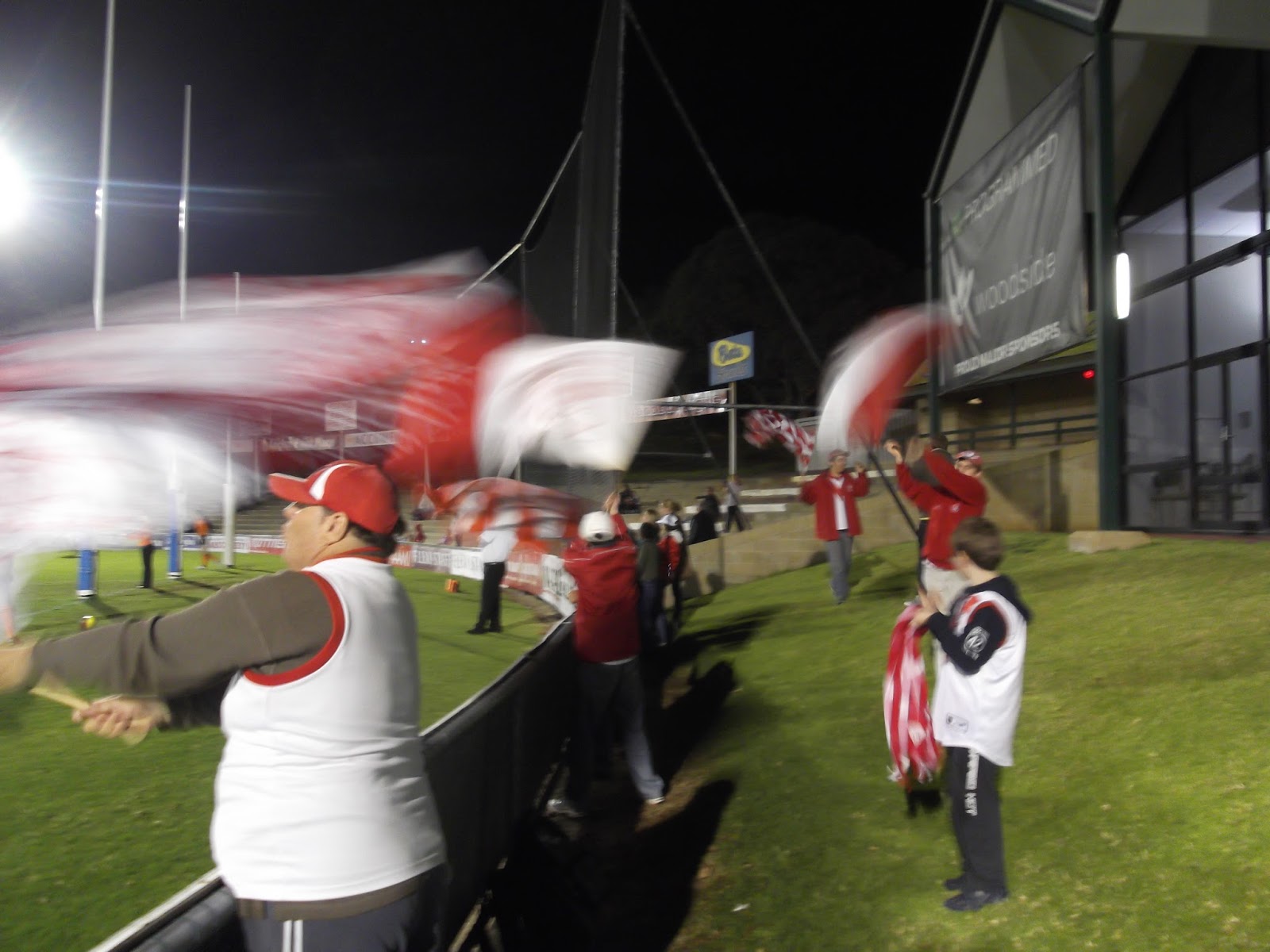
Kieran James @ Fremantle Oval main gates for Friday night match, South Fremantle versus Swan Districts, 17 August 2012, one of the coldest nights I can remember in Perth. The minimum temperature at Jandakot for the night of 17th-18th August 2012 was recorded officially at 3.2 degrees. Swan Districts won 17.18 (120) to South 13.7 (85) and the official attendance was 2,047. South was in the contest up until the late 3rd quarter or early 4th quarter and the South Fremantle Cheer Squad (behind the hospital-end goals) was excited and then later on very disappointed. 
Chris Egan at South Fremantle versus Swan Districts on a very cold Friday night, 17 August 2012.
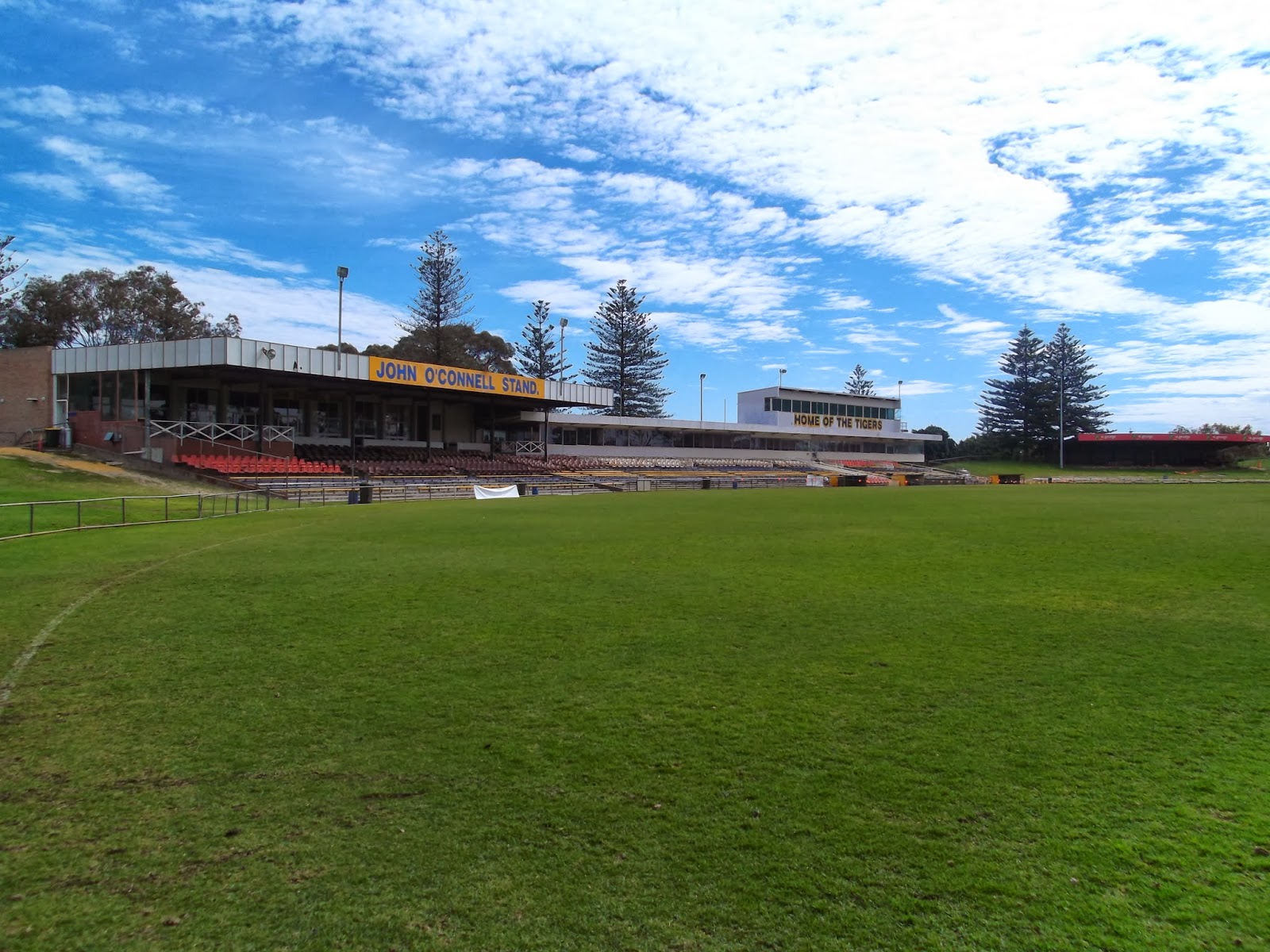
South Fremantle Cheer Squad (formed 2002). Wayne is the character in sleeveless South jersey and red cap at the far left of this picture. Patrick Mirosevich is second from left on the front row along the fence (red jumper and white cap). He can be seen more clearly in the other pictures. All match pictures were taken at South Fremantle versus Swan Districts, Friday night, 17 August 2012. Daytime pictures of Fremantle Oval were taken on the afternoon of 17 August 2012.

Thursday, 5 October 2017

ARTICLE: "Bassendean Oval: Home of hard men, on and off the field", by John Townsend, 18/9/2017

ARTICLE: As a boy growing up in Perth’s western suburbs in the 1970s, there were few prospects more terrifying than catching the train to Bassendean Oval to watch Claremont take on Swan Districts.

The train ride from Swanbourne was straightforward enough, even though the last couple of stops before Success Hill started to bring contact with characters best avoided once the game started.

A three-minute trot down Thompson Road, a right and then left to the main gates on Old Perth Road and you were in the ground.

Then the fun started.

The railway has played a major part in Swan Districts’ history, with Bassendean Oval’s position on the Midland line providing easy access to the city and eastern suburbs, which supplied many of its players over the decades.

Sports were played at the then Bassendean Reserve from the early part of the century, but it was the foresight of former South Fremantle player RA (Dick) McDonald in the mid-1920s, then a member of the Bassendean Road Board, that saw funds raised to convert Bassendean Oval into a facility suitable for senior football.

McDonald’s vision was to create a league club based in the district, a dream that would come true in 1934 when Swan Districts were admitted to the WA National Football League with their founding father the inaugural president.

Swans’ Haydn Bunton Jr vs. Perth, April 1964.
McDonald was also recognised with the naming of the 800-seat grandstand in his honour, an historic achievement lost on a small boy whose only ambition was to survive unscathed amid the most threatening football environment of his limited experience.

The RA McDonald Stand was the source of that terror; a wooden stand packed with the most ferocious and vocal supporters whose synchronised foot-stamping played tune to the fortunes of their team.

They had seen dark days — Swans failed to make finals for 15 consecutive seasons after World War II, a record that stood until Peel’s entry to the league nearly half a century later — followed by the most glorious reign as Haydn Bunton’s men won three straight flags from 1961.

Silky Bill Walker, a four-time Sandover medallist, roved alongside Bunton while Test cricketer Keith Slater dominated the ruck and a host of equally hard men, such as Ken Bagley, Tony Nesbit and Fred Castledine, played for keeps.

Bassendean Oval crowd, 1961
Swans struggled for success in the 1970s, as did Claremont, but their one or two battles a year at Bassendean were epic contests between two different worlds.

Crowds flocked to witness these encounters, with the crush in the outer only matched by that on the late train, with 10,000 and more fans often squeezed into the ground.

There were nearly that many on the devastating day in June 1976 when Claremont’s Norm Uncle kicked 10 goals, only for Swans’ Mark Olsen to answer with nine as the home team got the better of a 45-goal shootout.

It remains the closest any WAFL match has come to having opponents kick 10 goals.

[By John Townsend for The West Australian. This article was first published online on 18 September 2017 at the following link: https://thewest.com.au/sport/wafl/bassendean-oval-home-of-hard-men-on-and-off-the-field-ng-b88600154z]
Swan Districts versus West Perth at Bassendean Oval in 1964.
A game between Swan Districts and South Fremantle in 1962.

Tuesday, 3 October 2017

ARTICLE: "East Fremantle Oval: From sand and scrub to a footy fortress", by John Townsend, 20/9/2017

ARTICLE: Jack Sheedy grew up opposite East Fremantle Oval, so there was no question he would relish the chance to play on the ground he saw converted from a patch of sand and scrub into the home of the WAFL’s most successful club.

One of WA football’s most famous figures as his title Mr Football would suggest, Gentleman Jack — or Bible Jack as he was also known after offering to swear his innocence on a bible during one of his assorted tribunal appearances — Sheedy was at the peak of his powers when he first ran on to East Fremantle Oval in April 1953.

He was 26, already a veteran of 150 club games, two premierships, a couple of years as coach and countless stoushes when Old Easts moved from Fremantle Oval to their own premises a couple of kilometres east of the port town.

“I was born and bred here and lived in the street opposite when the ground was built,” Sheedy, now 90, recalled at his recent induction into the club’s hall of fame.

“My parents took me to the football every week and I would run errands for the players after training. It was and is a great place.”

The bar in the clubrooms was popular.
The ground would soon pay witness to another remarkable footballer — a teenage Graham Farmer, who made his league debut there for East Perth but showed little in a game played in foul weather that he would develop into perhaps the greatest player the game has seen.

East Fremantle were only eight years old when they played their sole season at the barren and distant ground in 1906 before returning nearly half a century later in 1953 to put down roots at a ground they could finally call their own.

The Sharks — as they have been known for the past three decades after seeking an identity with greater bite — are considering a 21st century move to share Fremantle Oval again but while that development is progressing at funereal pace, it is positively electric compared with the glacial move after World War II. Supply and manpower short-ages meant the development first mooted during the war years took nearly a decade to come to fruition and did not create instant success when it finally happened.

The Lofts boys kit up to enjoy the action.
Old Easts only took a few years to win another premiership — one of their WAFL record 29 and against Sheedy’s East Perth after his controversial club switch — but their most dominant years were behind them.

Yet the club continued to boast a host of the game’s brightest stars whose presence at East Fremantle Oval would drive some of the biggest crowds in the league.

A lanky young farmer from Jennacubbine joined the club at that time and Jack Clarke would go on to have one of the game’s great careers. He became the only player from any State to be named All-Australian at four consecutive national carnivals.

The stars were headed by Sheedy, of course, dual Sandover Medallist Ray Sorrell and a crop from the 1970s that included medal winners Brian Peake, Graham Melrose and David Hollins.

[By John Townsend for The West Australian. This article was first published online on 20 September 2017 at the following link: https://thewest.com.au/news/wa/from-sand-and-scrub-to-a-footy-fortress-ng-b88606129z]
The football oval (top) was located next to the now-defunct Richmond trotting track.
West Perth Cheer Squad, WP versus EF, northern- or city-end, East Fremantle Oval, 8 August 1981. This cheer squad was led by Pam Hynsen and also included David Barr. It operated for many years at the northern- or Technical School-end of Leederville Oval and at away games.

Monday, 18 September 2017

BOOK REVIEW: "Goodbye Leederville Oval" - More than an Oval, by Chris Egan, 12/9/2017

Chris Egan (left) and friend @ Dorrien Gardens Soccer Ground, North Perth. Neither Chris nor Kieran James have much time for code-wars.
Dr Kieran James’ book – Goodbye Leederville Oval is a unique and credible insight into Perth’s sporting culture. It covers three major themes – the fluidity of Perth’s sporting culture, the pain of transition in Australia of sports moving from semi-professional to professional pathways and one that is currently being further examined across the state. What is it to be a Western Australian?

James uses soccer to elicit his supporter group as part of an intimidatory force and uses the literature from the United Kingdom soccer scene to introduce his supporter group. It is the fluid connections that come through that are the highlight of the experiences of Kieran’s youth. There is a transient connection to the WAFL by boys of his generation, especially when compared to the intensity of support in the VFL.  This is challenged by the ‘parochialism’ at state level which superseded the interest in metropolitan clashes. 

Dedication came with the ‘cultural’ acceptance that kids would be ‘permissed’ to wag school to watch the WA state team play Victoria. That this was something that ‘everyone’ did. This is where the real heart of sporting culture comes alive, something that saw little ability to be transient. The pride of their Western Australian identity was at a peak, school was nowhere near as important and there was a ‘tactful’ acceptance of this by the Education Department with not cracking down on it.

For Kieran, there is ever-lasting pain from the transition as he has a strong engagement to the league and the game. But he is also part of the fluidity, he sees no difference between his love of Dorrien Gardens and Leederville Oval, the culture he critiques allows him to create a book with no code hostility. He crosses over League, Soccer and Australian Rules throughout this book, framed by a city which as a whole allows people to pick and choose what elements of Western Australian society that you engage with.

It doesn’t require you to stay with West Perth and the Eagles. It doesn’t require you to ignore academic literature from soccer to frame the experience of an Australian Rules cheer squad. There is a freedom of affiliation that is bound by the cultural and social freedom to interact in the many world’s of Perth – with no social, academic or economic punishment.

It is expertly sourced, referenced and memorialised. He transects a critical lense on Western Australian societies ‘either/or’ rather than ‘yes/and’ which he suggests is framed by the West Coast Eagles who were able to delineate the attachment to the Western Australian State of Origin side when it was created in 1987.  James challenges this with how Queenslanders supported their Rugby League club sides and their State of Origin heroes. That in Perth this eroded and the passion of the state was transferred to its club side.

The processes of the construction of this period is critical for future studies into the game, including my present book on Perth Glory which utilised the passion behind the WA state side which was then transferred into the ground-breaking records that Perth Glory attracted when it entered into the National Soccer League in 1996. It provides further understandings that sport in WA is fluid, it is about state pride at its heart – not the code of sport you play.  

Kieran James @ Leederville Oval
What is the highlight though is the insight into mid 80s supporter culture in Western Australia, the lack of class, political and social friction within James supporter group is similar to my experience when part of the home end at Perth Glory. The group I sung with was from all walks of life, but our connection was our united passion for the Glory, which is shaped by our shared strength of Western Australian identity.

If there is any critique of the book, is that it did not look at the clash points within Leederville Oval when Perth Glory tried to transfer the ground into a rectangular venue. With so much insight and academic theory being integrated from a soccer background, this would have been a valuable area to analyse by James.

The book is integral for anybody that is interested in Perth’s sporting and social history, it engages with the reader a mixture of memoir/analysis of the pain of reform. It crosses code boundaries and defines the characteristics of Western Australian society.

Dr Kieran James should be congratulated on a text that will have long-standing benefits to the study of sports history in Western Australia.

[This review was first published at Australianrules.com.au and is used here with the kind permission of Chris Egan.]


Also available on Amazon (type the book title into the search function). 

Monday, 4 September 2017

NEWS: West Australian Football Golden Era 1984-86 book published, 4 September 2017

Back cover of book (the can bar, Lathlain Park for Perth versus Swan Districts, 2 July 2011).
Paperback version
Message from the author Kieran James: "If you enjoyed this blog, the book is now finally available in paperback. Topic: West Australian Football Golden Era 1984-86. The book looks at the big games and main players in the Western Australian Football League (WAFL) over this period 1984-86".

SUMMARY: This book is the memoir of Kieran James, and details his experiences as co-founder of West Perth Football Club’s unofficial cheer squad from 1984 to 1986. The book shows how, because of neo-liberal ideologies and the corporatization of football, the new national league (the “expanded VFL” / AFL) relegated the WAFL to a second-tier league in 1987. This move took place over the heads of ordinary football supporters and two WAFL club presidents. Moves to bring the game closer to the people in 1984, such as holding the best-and-fairest award count night at Perth Entertainment Centre, should be seen in this light. This book will allow supporters to relive great teams, great players, and great matches from a wonderful era in WA football 1984-86 before West Coast Eagles joined the expanded VFL.

Hardcover version
AUTHOR BIO: Dr Kieran James is a Senior Lecturer in Accounting at the University of the West of Scotland, Paisley, Renfrewshire, Scotland.  He was formerly Accounting Professor at the University of Fiji from 2013-15. Alongside his high-school friend Michael Blewett, he was co-founder of the West Perth Cheer Squad (WAFL), 1984-86. He is the founder of the WAFL Golden Era website (established 18 December 2011) at http://waflgoldenera.blogspot.com which has had over 100,000 unique page-views as at 18/2/2017. Kieran is also a regular contributor to the Say NO to any AFL clubs in the WAFL Facebook group. He has published an academic journal article: “Where to now, Melbourne Croatia? Football Federation Australia’s use of accounting numbers to institute exclusion upon ethnic clubs” in Asian Review of Accounting (Vol. 19, No. 2, 2011). He is presently researching Fiji Soccer History 1980-89. His Fiji Soccer History website Nadi Legends Club can be viewed at the following URL: http://nadilegendsclub.blogspot.com. His email contact addresses are: Kieran.James@uws.ac.uk and Kieran.James99@yahoo.co.uk and his Facebook page is at: https://www.facebook.com/kieran.james.94 [Kieran James].

OPINION: On the Prison Bars: From Destiny by Dr Norman Ashton (2018), p. 153.

From Destiny by Dr Norman Ashton (2018), p. 153: Given who the opponent was to be in 1997, a letter of 1 September 1995 from Collingwood Pre...