Friday, 13 October 2017

ARTICLE: "Perth Oval: Chestnuts, plane flights and Royal rumbles fro East Perth", by John Townsend, 14/9/2017

ARTICLE: The tale of Charlie Chandler’s tree blossomed in the late 1950s but it was the chestnut’s failure to flower in 1961 that made the myth a legend.

The famous tree was a Perth Oval landmark for many decades, but the significance of its rare blooming was not recognised until Chandler, a returned World War II soldier and rabid East Perth supporter, identified several serendipitous events.

Chandler made the tree a barometer of East Perth premiership chances when he pointed out that, after many years without a flower, it had blossomed in 1956, 1958 and a year later.

They were all seasons that the Royals won the flag as a cohort of outstanding players in Graham “Polly” Farmer, Ted “Square” Kilmurray and John K. Watts combined superbly under inspirational coach Jack Sheedy.

East Perth were red-hot favourites in 1961, having beaten Swan Districts four times in the season, but the tree would not flower.

The bare tree proved a powerful omen.

Swans would go on to win the premiership, while the fact that Chandler’s tree had refused to blossom soon became a totem of the club’s rotten decade in which it made the grand final six times but lost each one of them.

The 1960s were a period of lost opportunities and a stark contrast to East Perth’s early days at Perth Oval when the ground regularly hosted the grand final and interstate matches.

Accepted into the competition in 1906 — with only West Perth voting against their inclusion to ignite a bitter rivalry that exists to this day — East Perth soon moved to the then Loton’s Park on the outskirts of the CBD where they would build a WAFL empire.

Phil Matson, a brilliant player at four WAFL clubs who would prove an even more formidable coach, was the catalyst.

He steered the club to five consecutive premierships from 1919, had a successful year in Victoria before returning to win two more flags and could have achieved anything in the game but for his death in a car crash at the age of 43.

Sheedy won three flags and returned for one season in 1969 when Perth Oval witnessed a series of remarkable events only two years after it was passed over in favour of Subiaco Oval as the site of WA football’s headquarters.

It was the year the mercurial Mal Brown won the Sandover Medal to make the first of a series of indelible marks on the game, while East Perth’s standing as the league’s most popular club was underlined when more than 20,000 fans packed the ground early in the season.

The Foundation Day match against West Perth then drew a remarkable 26,760 spectators to smash the WAFL home-and- away attendance record.

It was the biggest crowd at the ground since 1928 when it appeared most of Perth turned out to watch Bert Hinkler take off on the first solo flight from Australia to England.

Chandler’s tree did not flower when East Perth won the 1972 flag, though there was plenty of colour that night when captain-coach Brown led a player walk-out during the celebrations because the recently retired Derek Chadwick was denied access to the official function.

East Perth would remain at the ground for two more decades but the glory days were over.

After a period at the WACA Ground, the Royals shifted to Leederville.

Perth Oval would be redeveloped as a rectangular stadium that would host the Perth Glory soccer club and the Western Force rugby union club.

[By John Townsend for The West Australian. This article was first published at the following link: https://thewest.com.au/news/wa/uncanny-chestnut-predicted-the-royals-highs-and-lows-ng-b88599502z]
East Perth versus East Fremantle, 1965
Centre-man Syd Jackson and other players at training, 1964
Mal Atwell and happy schoolboys
East Perth's Phil Tierney after an incident with East Fremantle's Con Regan in May 1962.
An air-raid demonstration at the oval in 1940.
John Watts, Ralph Rogerson, Ray Rowlles, and Brian Grant, March 1962.
Perth Oval as a rectangular stadium. This picture shows the kick-off of the friendly match between Glasgow Celtic and Perth Glory on 9 July 2011 which was won 2-0 by the Scottish giants.
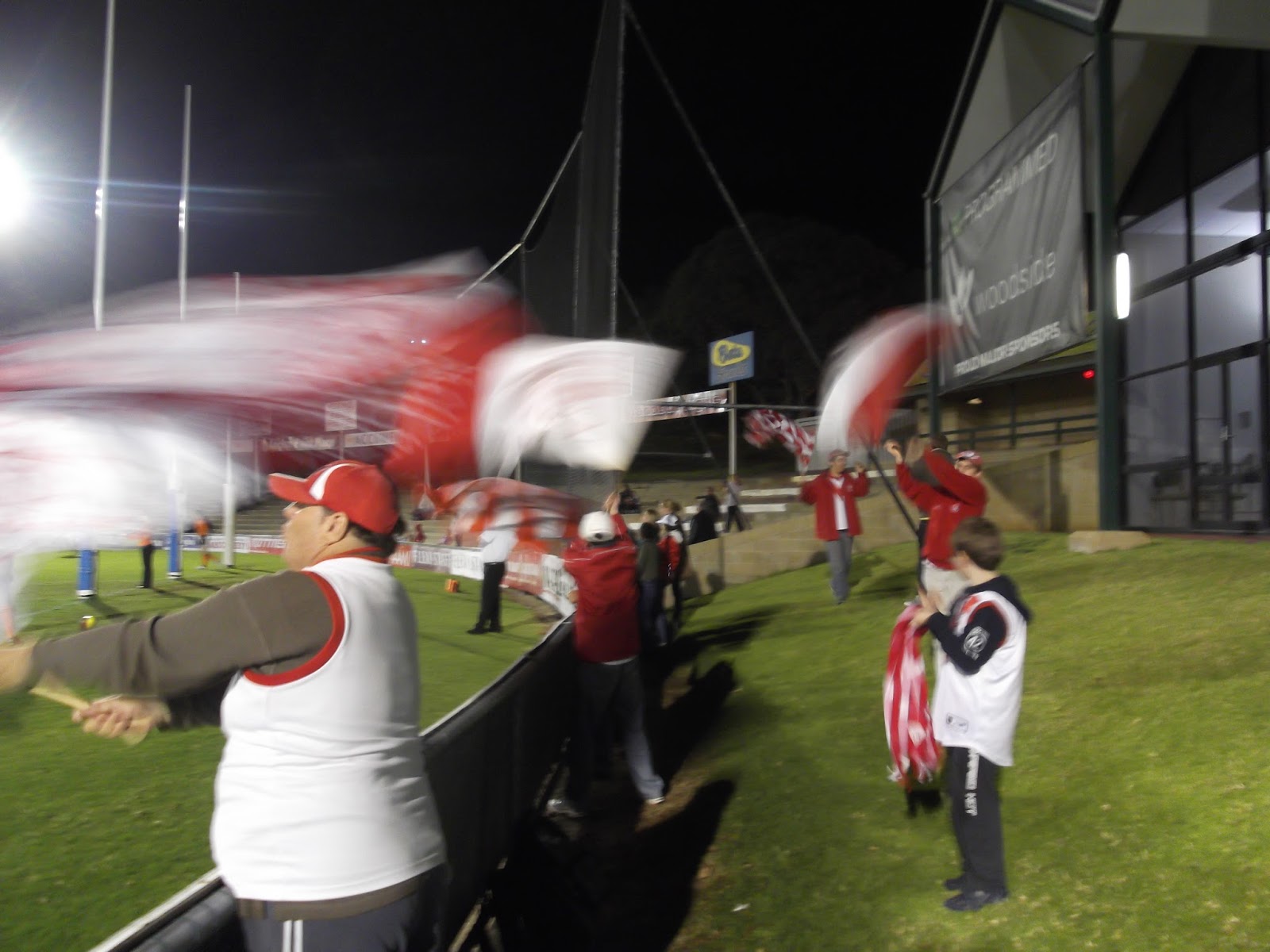
East Perth Cheer Squad which was active from the years 1982-88 according to David Lockhart. That ROYALS 82 banner indeed became very well-known to WAFL fans back in the day (photo courtesy of David Lockhart / Lost WAFL Facebook page). I'm only guessing but this picture might be from early in the day of the 1982 First Semi-Final East Perth versus West Perth (when you had to arrive very early to obtain seats directly behind the fence).

ARTICLE: "Looking back at the glory days of Fremantle Oval", by John Townsend, 13/9/2017

ARTICLE: It remains the most remarkable individual performance in WA football history.

Bernie Naylor, the outstanding South Fremantle full-forward famous for his arrow-straight torpedo punt kicks, launched 29 shots at goal against Subiaco one fine August day in 1953.

All but six hit their target, but after kicking 23 goals to smash the WA record and equal the best for anyone around the country, Naylor refused to accept any more passes and spent some of the game leaning on a goalpost.

He had done enough, as he confirmed with the modesty of his comments after the slaughter.

“This is a great day for me but without the assistance of my teammates, I could not have broken the record,” Naylor said.

“They had to get the ball and give it to me. All I had to do was kick it.”

Naylor already shared the WA goal-kicking record in a match with East Fremantle’s George Doig and Claremont’s George Moloney after kicking 19 at Fremantle Oval the previous year and warmed up with 18 goals against the hapless Subiaco three months earlier.

Naylor’s momentous match was the highlight of a career that is likely to receive belated recognition next year with his induction into the Australian Football Hall of Fame.

There was another momentous event at the ground that season, with East Fremantle leaving their half-century home to forge their future at East Fremantle Oval 2km to the east.

And South Fremantle overcame strenuous objections from the usual suspects — police, neighbouring hotels and the Temperance League — to get a liquor licence, an achieve-ment of considerable foresight given the celebrations later that year when the club won the middle leg of its eventual premiership hat-trick.

Fremantle Oval started as Barrack Green, the recreation ground for the Pensioner Guards who supervised WA’s convicts, and soon hosted its first match only two months after the formation of the WA Football Association, the precursor to the WAFL.

It would eventually host four clubs and showcase a century of champions such as Albert “The Great” Thurgood, bitter rivals and great mates Steve Marsh and Jack Sheedy, and modern-day star Stephen Michael.

It was the training base for the Fremantle Dockers for their first 20 years.

The original Fremantle team, which lasted only two years before folding, drew with Rovers in their initial outing despite scoring 11 behinds to their opponent’s five. Under the rules of the game’s first decade, only goals counted towards the result.

Unions replaced the original Fremantle before soon adopting the same name, but they were to last little more than one tumultuous decade before they folded and current teams South Fremantle and East Fremantle came into being.

[This article was first published by John Townsend for The West Australian at the following link: https://thewest.com.au/news/wa/naylor-king-of-goal-feasts-ng-b88597924z]

South Fremantle versus Swan Districts, 1968
Bernie Naylor (South Fremantle)
Kieran James @ Fremantle Oval main gates for Friday night match, South Fremantle versus Swan Districts, 17 August 2012, one of the coldest nights I can remember in Perth. The minimum temperature at Jandakot for the night of 17th-18th August 2012 was recorded officially at 3.2 degrees. Swan Districts won 17.18 (120) to South 13.7 (85) and the official attendance was 2,047. South was in the contest up until the late 3rd quarter or early 4th quarter and the South Fremantle Cheer Squad (behind the hospital-end goals) was excited and then later on very disappointed. 
Chris Egan at South Fremantle versus Swan Districts on a very cold Friday night, 17 August 2012.
South Fremantle Cheer Squad (formed 2002). Wayne is the character in sleeveless South jersey and red cap at the far left of this picture. Patrick Mirosevich is second from left on the front row along the fence (red jumper and white cap). He can be seen more clearly in the other pictures. All match pictures were taken at South Fremantle versus Swan Districts, Friday night, 17 August 2012. Daytime pictures of Fremantle Oval were taken on the afternoon of 17 August 2012.

Thursday, 5 October 2017

ARTICLE: "Bassendean Oval: Home of hard men, on and off the field", by John Townsend, 18/9/2017

ARTICLE: As a boy growing up in Perth’s western suburbs in the 1970s, there were few prospects more terrifying than catching the train to Bassendean Oval to watch Claremont take on Swan Districts.

The train ride from Swanbourne was straightforward enough, even though the last couple of stops before Success Hill started to bring contact with characters best avoided once the game started.

A three-minute trot down Thompson Road, a right and then left to the main gates on Old Perth Road and you were in the ground.

Then the fun started.

The railway has played a major part in Swan Districts’ history, with Bassendean Oval’s position on the Midland line providing easy access to the city and eastern suburbs, which supplied many of its players over the decades.

Sports were played at the then Bassendean Reserve from the early part of the century, but it was the foresight of former South Fremantle player RA (Dick) McDonald in the mid-1920s, then a member of the Bassendean Road Board, that saw funds raised to convert Bassendean Oval into a facility suitable for senior football.

McDonald’s vision was to create a league club based in the district, a dream that would come true in 1934 when Swan Districts were admitted to the WA National Football League with their founding father the inaugural president.

Swans’ Haydn Bunton Jr vs. Perth, April 1964.
McDonald was also recognised with the naming of the 800-seat grandstand in his honour, an historic achievement lost on a small boy whose only ambition was to survive unscathed amid the most threatening football environment of his limited experience.

The RA McDonald Stand was the source of that terror; a wooden stand packed with the most ferocious and vocal supporters whose synchronised foot-stamping played tune to the fortunes of their team.

They had seen dark days — Swans failed to make finals for 15 consecutive seasons after World War II, a record that stood until Peel’s entry to the league nearly half a century later — followed by the most glorious reign as Haydn Bunton’s men won three straight flags from 1961.

Silky Bill Walker, a four-time Sandover medallist, roved alongside Bunton while Test cricketer Keith Slater dominated the ruck and a host of equally hard men, such as Ken Bagley, Tony Nesbit and Fred Castledine, played for keeps.

Bassendean Oval crowd, 1961
Swans struggled for success in the 1970s, as did Claremont, but their one or two battles a year at Bassendean were epic contests between two different worlds.

Crowds flocked to witness these encounters, with the crush in the outer only matched by that on the late train, with 10,000 and more fans often squeezed into the ground.

There were nearly that many on the devastating day in June 1976 when Claremont’s Norm Uncle kicked 10 goals, only for Swans’ Mark Olsen to answer with nine as the home team got the better of a 45-goal shootout.

It remains the closest any WAFL match has come to having opponents kick 10 goals.

[By John Townsend for The West Australian. This article was first published online on 18 September 2017 at the following link: https://thewest.com.au/sport/wafl/bassendean-oval-home-of-hard-men-on-and-off-the-field-ng-b88600154z]
Swan Districts versus West Perth at Bassendean Oval in 1964.
A game between Swan Districts and South Fremantle in 1962.

Tuesday, 3 October 2017

ARTICLE: "East Fremantle Oval: From sand and scrub to a footy fortress", by John Townsend, 20/9/2017

ARTICLE: Jack Sheedy grew up opposite East Fremantle Oval, so there was no question he would relish the chance to play on the ground he saw converted from a patch of sand and scrub into the home of the WAFL’s most successful club.

One of WA football’s most famous figures as his title Mr Football would suggest, Gentleman Jack — or Bible Jack as he was also known after offering to swear his innocence on a bible during one of his assorted tribunal appearances — Sheedy was at the peak of his powers when he first ran on to East Fremantle Oval in April 1953.

He was 26, already a veteran of 150 club games, two premierships, a couple of years as coach and countless stoushes when Old Easts moved from Fremantle Oval to their own premises a couple of kilometres east of the port town.

“I was born and bred here and lived in the street opposite when the ground was built,” Sheedy, now 90, recalled at his recent induction into the club’s hall of fame.

“My parents took me to the football every week and I would run errands for the players after training. It was and is a great place.”

The bar in the clubrooms was popular.
The ground would soon pay witness to another remarkable footballer — a teenage Graham Farmer, who made his league debut there for East Perth but showed little in a game played in foul weather that he would develop into perhaps the greatest player the game has seen.

East Fremantle were only eight years old when they played their sole season at the barren and distant ground in 1906 before returning nearly half a century later in 1953 to put down roots at a ground they could finally call their own.

The Sharks — as they have been known for the past three decades after seeking an identity with greater bite — are considering a 21st century move to share Fremantle Oval again but while that development is progressing at funereal pace, it is positively electric compared with the glacial move after World War II. Supply and manpower short-ages meant the development first mooted during the war years took nearly a decade to come to fruition and did not create instant success when it finally happened.

The Lofts boys kit up to enjoy the action.
Old Easts only took a few years to win another premiership — one of their WAFL record 29 and against Sheedy’s East Perth after his controversial club switch — but their most dominant years were behind them.

Yet the club continued to boast a host of the game’s brightest stars whose presence at East Fremantle Oval would drive some of the biggest crowds in the league.

A lanky young farmer from Jennacubbine joined the club at that time and Jack Clarke would go on to have one of the game’s great careers. He became the only player from any State to be named All-Australian at four consecutive national carnivals.

The stars were headed by Sheedy, of course, dual Sandover Medallist Ray Sorrell and a crop from the 1970s that included medal winners Brian Peake, Graham Melrose and David Hollins.

[By John Townsend for The West Australian. This article was first published online on 20 September 2017 at the following link: https://thewest.com.au/news/wa/from-sand-and-scrub-to-a-footy-fortress-ng-b88606129z]
The football oval (top) was located next to the now-defunct Richmond trotting track.
West Perth Cheer Squad, WP versus EF, northern- or city-end, East Fremantle Oval, 8 August 1981. This cheer squad was led by Pam Hynsen and also included David Barr. It operated for many years at the northern- or Technical School-end of Leederville Oval and at away games.

OPINION: On the Prison Bars: From Destiny by Dr Norman Ashton (2018), p. 153.

From Destiny by Dr Norman Ashton (2018), p. 153: Given who the opponent was to be in 1997, a letter of 1 September 1995 from Collingwood Pre...