Tuesday, 10 April 2018

Round 19, 1986: South Fremantle FC 24.18 (162) d West Perth FC 16.11 (107), Fremantle Oval

South Fremantle versus West Perth, Fremantle Oval, Round 19 (9 August), 1986

I once talked to Pete C. and spent the game with him on the scoreboard bank’s concrete terracing at Fremantle Oval (at around the half-forward flank position closest to the northern-end goals) for a match against South Fremantle late in the 1986 season. The West Perth Cheer Squad’s flags had vanished and there was only the two of us left at this juncture in time. Pete C. and I hadn’t even arranged in advance to meet; it was a chance meeting. I would have to say that the cheer squad no longer existed at this point. However, Pete’s charming, quiet, and thoughtful manner had not changed.

After the game Pete C. and I walked through the Fremantle city streets together and I think Pete took a Number 106 bus or a train back to Perth while I took a different bus to Booragoon. We probably parted at Fremantle train station. I originally wrote this paragraph 26 years later, on 9 January 2013, and I still haven’t seen Pete again since that day at Fremantle Oval near to the close of the 1986 season. As we walked through the Fremantle city streets together, as the dark and the chill started drifting in from the ocean (minimum temperatures were 4.5 and 4.0 degrees Celsius on Saturday 9th and Sunday 10th August 1986), we were both fairly subdued and disappointed as it looked like our team’s season was over (the team probably could not make the final-four) and all the hope of the past two years had come to nothing. I think that another reason for my anxious and melancholic mood was the realization, pushed to the back of my mind, that my life was changing and it would never be the same again. I was 17-years-old, in the first year of university, and the adult world of responsibilities, choices, careers, and consequences was fast closing in, whilst childhood was at an end. In football terms, there was also massive change at work behind the scenes as the powerbrokers were putting together and planning for the new as yet unnamed super-team which would play in the VFL in 1987. Every genuine football person in Perth knew that the WAFL would never be the same again no matter how upbeat the newspapers were. Like my childhood, the old WAFL was slipping away. The days of 14,000 plus crowds at the match-of-the-round were never coming back (source: WAFL Football Golden Era, by Kieran James, page 153, book is available on Lulu and Amazon).

Likely line-ups:
(Source: The West Australian, Saturday, 9 August 1986, p. 187)
South Fremantle FC
Backs: Macdonald, Carter, Maskos
Half-backs: D Wilson, Sumich, Mosconi
Centres: B Collard, Bairstow, Lynch
Half-forwards: Winmar, Hutcheson, Todd
Forwards: Bennett, M Sambrailo, D Collard
Ruck: Edwards, Worsfold, Matera
Interchange: Lockhart, Sims
West Perth FC
Backs: Munns, Mugavin, Barns
Half-backs: Binder, Mifka, Turley
Centres: D Bewick, Bell, King
Half-forwards: Menaglio, Bradmore, Lill
Forwards: Waddell, Foley, Gastev
Ruck: Nelson, Fong, C Bewick
Interchange: Collinge, Martin
In: Waddell, Collinge, Martin
Out: Laidley (ankle), Chaplin (ankle), Bennett

Match preview
By David Marsh:
“Today is D-Day – do-or-die – for West Perth, who have their last chance to stake a claim for a berth in this year’s finals.
“And they could not have a tougher assignment, as they meet giant-killers South Fremantle at Fremantle Oval.
“South have had victories over Subiaco and Perth in the past three weeks. In addition, West Perth have not won at Fremantle Oval for eight years”.

Match results – Saturday, 9 August, 1986, Fremantle Oval
South Fremantle FC 7.5 16.10 21.12 24.18 (162) d West Perth FC 3.5 6.6 10.9 16.11 (107)
Scorers: SF: Edwards 5.3, Matt Sambrailo 5.1, Winmar 4.2, Matera 4.1, D Collard, Bairstow 2.2, Hutcheson, Todd 1.0, B Collard 0.2, Worsfold, Lockhart 0.1, Forced 0.3.
WP: Gastev 3.2, Bradmore 2.1, Fong, King, D Bewick 2.0, C Bewick, Collinge 1.2, Foley, C Nelson 1.1, Menaglio, Lill 0.1. [KJ note: One WP goal seems to be missing from this list.]
(Source: The West Australian, Monday, 11 August 1986, p. 101)
Weather: Fine, light south-westerly breeze.
(Source: The West Australian, Monday, 11 August 1986, p. 101)
Attendance: 5,872 (from WAFL Online)
Free-kicks: SF: 7, 4, 4, 3 – 18.
WP: 4, 5, 4, 1 – 14.

Best players:
WA Footballer of the Year Award:
5 votes Wally Matera (South Fremantle) – A brilliant 22-kick, four-goal display of roving.
4 votes Mark Bairstow (South Fremantle) – Another strong, creative performance at centre where he was under notice from the start.
3 votes Craig Edwards (South Fremantle) – A quality performance in the ruck and when resting in attack. Marked brilliantly and kicked four goals.
2 votes Warren Mosconi (South Fremantle) – A dashing and effective half-back who was outstanding in a solid South defence.
1 vote Peter Sumich (South Fremantle) – A notable performance at centre-half-back against Phil Bradmore.
(Source: The West Australian, Monday, 11 August 1986, p. 100)

Team rankings: SF: W Matera 1, M Bairstow 2, C Edwards 3, W Mosconi 4, P Sumich 5, D Collard 6.
WP: J Gastev 1, C Nelson 2, C Binder 3, L Fong 4, C Turley 5, C Bewick 6.
(Source: The West Australian, Monday, 11 August 1986, p. 100)


Rd. 19


P
W
L
D
%
Pts
SUBI*
19
15
4
-
134.56
60
E FREM**
19
14
5
-
132.29
56
PERTH
19
12
6
1
105.06
50
CLARE
19
10
9
-
119.01
40
W Perth
19
8
10
1
89.54
34
S Frem
19
6
13
-
72.80
24
S Dist
19
5
14
-
86.09
20
E Perth
19
5
14
-
82.24
20
(Source: The West Australian, Monday, 11 August 1986, p. 101)
*eventual 1986 WAFL premiers
**eventual 1986 WAFL runners-up

Leading goal-kickers after Round 19 (Top 9 players):
80 – Mick Rea (P)
71 – John Scott (C)
55 – Warren Dean (S), Stephen Sells (S), Colin Waterson (EF)
53 – Brian Peake (EF)
48 – Wayne Ryder (P), Craig Edwards (SF)
41 – Tony Buhagiar (EF)
(Source: The West Australian, Monday, 11 August 1986, p. 101)

Complete match report (full-text):
By the late GEOFF CHRISTIAN:
“South Fremantle are at the start of a bright [new] era in league football based on an excellent mix of raw talent and enthusiasm, blended with the right amount of experience.
“That formula was the basis of South’s scintillating 55-point win over West Perth at Fremantle Oval on Saturday, a victory full of merit and one that should help guarantee that the season ends a lot happier than it started for the Bulldogs.
“An indication of the amount of ability available at Fremantle Oval these days can be gauged by the fact that gifted veterans Benny Vigona and Willie Roe were in action in the reserves on Saturday.
“The absence of these brilliant attacking players obviously did not hamper South who kicked their season’s highest score [of] 24.18 and almost kicked the Falcons out of business.
“West Perth arrived at Fremantle Oval on Saturday knowing that victory was a stepping stone into the final four. It was not an easy task on an oval where the ground surface is obviously a big advantage for the home team.
“The Falcons left four hours later without even touching that stepping stone and failed miserably to measure up to the challenge laid down by South.
“The victory was built around superb performances by No. 1 rover Wally Matera (their smallest player), ruckman Craig Edwards (their biggest player) and centreman Mark Bairstow, who fitted neatly in the middle.
“[Wally] Matera has not given a better display of his roving skills. His work at the fall of the ball was classical in style and he made few, if any, handling errors.
“Edwards’ marking and general ruck play was superb and the same could be said of Bairstow whose powerful work in the middle was of the quality West Perth wished they had available to them.
“South had plenty of other individual stars but it was more the spirit and the team co-operation revealed by this young Bulldogs’ line-up that West Perth found impossible to match for all but the opening 12 minutes.
“Everywhere West Perth turned on Saturday they found trouble. On a day dedicated to national dental health week, West Perth simply bit off more than they could chew.
They lacked the bite of the Bulldogs; there was [sic] too many gaps in their play and too many weak spots that obviously were tender to the probe.
“It was not a day when centre-half-forward Phil Bradmore could lead the Falcons out of trouble. He was well held by Peter Sumich, a first year player who started the season in attack but looked admirably suited at centre-half-back.
“There was plenty of defensive support for Sumich, mainly from Warren Mosconi, Gavin Carter and Arthur Maskos.
“Things were no better in defence for West Perth.
“Matt Sambrailo, who started the year for South on a wing, showed natural flair at full-forward when he kicked 5.1 and Barry Hutcheson has the look of a man who knows how to play at centre-half-forward.
“And to add to the woes of the West Perth defence, Neil Winmar [later “Nicky” Winmar] decided to show how well he can play at centre with a 17-kick, four-goal effort”.
(Source: Geoff Christian (1986), “Bulldogs find a formula for success”, The West Australian, Monday, 11 August 1986, p. 100)
Night-time match pictures are from an equally freezing cold Fremantle Oval (WAFL) game. This time the match was on Friday night, 17 August 2012 versus Swan Districts. Pictures show South Fremantle Cheer Squad (formed 2002), featuring Wayne (red cap and white SFFC sleeveless jersey) and Patrick (white cap and red jacket) among others.

Tuesday, 13 March 2018

OPINION: "Why the West Coast Eagles' initial 1987 playing squad was faulty", by Jack Frost, 13/3/2018

West Coast Eagles’ inaugural playing squad (1987)
The official WPFC historian Brian Atkinson states that West Perth sometimes did not receive its fair share of state team representatives in years when the club made the finals. Atkinson comments that: “The failure of any West Perth player to gain state selection in 1984 was a matter of great controversy within the West Perth camp”, especially as the club was in third place at the time the team was selected (only to eventually miss the finals). The West Coast Eagles’ initial 35-man squad for season 1987 was also disheartening for some West Perth supporters.

The five West Perth players chosen were: John Gastev, Sean King, Dean Laidley, Paul Mifka, and Dean Warwick with King being a later addition to the original 32-player squad which was first announced at the official launch at Perth’s Merlin (now Hyatt) Hotel. These players were bright and promising youngsters but arguably, with the exception of Laidley and perhaps Gastev, they had not yet developed the consistency or backlog of strong performances to merit selection. The five West Perth players in the initial West Coast squad were clearly chosen, if not at random, then by people largely disrespectful or apathetic towards the club.

Favourite sons of the club, such as Phil Bradmore, Les Fong, and Peter Menaglio were wilfully overlooked although their careers were still active and their playing performances were still strong. Although Brian Atkinson “did not have any strong feelings either way”[1], he states “you would have to include Fong and Menaglio” as the top two players for the club during the drought-era and prior to the formation of West Coast (i.e. 1976-86). Both Fong and Menaglio were named in the club’s “Team of the Century”, Menaglio on the left-wing and Fong as the first rover. Menaglio continued to play senior football with West Perth up until the 1989 season so he was hardly “over the hill” by late 1986. Bradmore’s birth-date is 2 April 1959; Fong’s is 24 August 1956 whilst Menaglio’s is 4 September 1958, making these three players 27, 30, and 28-years-of-age, respectively, as at October 1986. (As mentioned, Menaglio won the Breckler Medal for club fairest-and-best in 1984 whilst Bradmore won it the following year. Menaglio was also equal runner-up behind the three tied winners for the 1984 Sandover Medal. Les Fong was a close runner-up to Menaglio in the 1984 Breckler Medal count and, from 1981-84, Menaglio and Fong shared four Breckler Medals.) Fong top-scored for the club with 14 votes at the 1986 Sandover Medal count, won by Mark Bairstow of South Fremantle, although, astonishingly, there were no West Perth players in the top 24 (yes, read that again, it is not a typo).[2]

Peter Menaglio (WPFC)
Also worthy of consideration for selection by West Coast in late 1986 were Corry Bewick, Derek Kickett, and George Michalczyk. A newspaper report at the time suggested that Darren Bewick, younger brother of Corry, was not chosen because he had elected to remain in Perth for two more years to complete his teaching degree.[3] It appears that West Perth was unfashionable for the corporate set that was running West Coast, compared to players from East Fremantle and Subiaco, despite the fact that West Perth had beaten East Fremantle consistently in 1985. The disrespect shown to the club’s favourite sons, and especially to Bradmore, Fong, and Menaglio, rankled with some West Perth supporters. It would have been a mark of respect to Fong and to the club if Fong had been selected, if only for one or two seasons, in the same way that Robert Wiley of Perth Demons (formerly of Richmond) had been brought into the West Coast squad for 1987 at the twilight of that player’s esteemed career.

West Coast’s initial squad was chosen for the future and, in hindsight, we might fail to realize how young the players were then since now, looking back, we remember the distinguished VFL/AFL careers that many of that initial squad went on to have. Even Phil Narkle was allegedly only 24-years-old despite already having played at St Kilda for three seasons.[4] (In fact The West Australian of 31 October 1986 was in error: Narkle was actually 25-years-old as at 31 October 1986. The ninth 2011 edition of The Encyclopaedia of AFL Footballers at page 627 lists his birth date as being 29 January 1961.) Don Holmes (27-years-old), Glendinning (30), Turner (27), and Wiley (31) were the only inaugural West Coast players aged over 25 as at 31 October 1986 according to The West Australian.[5] It seems that the general principle which guided selection was to only select players aged over 25 if they had prior VFL/AFL experience. Bradmore’s prior VFL/AFL experience seems to have been either forgotten or discounted. In hindsight, at least, West Coast erred with its selection of the five West Perth players in 1987 or it clearly picked players that it had no real intention, in advance, of awarding game time to. King and Mifka managed only one game each for West Coast and Warwick played zero. Early Eagles squad members from Swan Districts such as Kevin Caton (1 West Coast game, 1988); Joe Cormack (10 games, 1988); Don Holmes (23 games, 1987-89); Brent Hutton (13 games, 1988-89); and Don Langsford (zero games) suffered similar fates which further soured the relationship between Swans and West Coast.

Derek Kickett, Les Fong (WP)
At the 1986 Sandover Medal count Laidley was equal second among West Perth players with 13 votes while Gastev was fourth highest with 11 votes. However, Warwick and King were way down the list, polling only two votes each and coming in at equal 15th for the club, while Mifka polled no votes at all. West Perth supporters could be forgiven for having being somewhat mystified about the five West Perth players selected. Had they been picked with only a bare minimum of thought just to make up the numbers with the West Coast leadership having had no serious prior intention of awarding any of them serious game time? Were people like Ron Alexander and Graham Moss unduly influenced by old WAFL club rivalries which led to them give insufficient thought to the selection of West Perth players and insufficient respect to the players who had played best for West Perth in the prior three seasons? West Perth’s 1986 Sandover Medal vote-getters’ list should have been given more respect and consideration by the West Coast leaders.

Phil "Spock" Bradmore (WPFC)
Apart from Laidley, only Gastev later had anything resembling a successful VFL/AFL career and the vast majority of his games (113 out of 143) were played with the Brisbane Bears. Similarly, Laidley is better known today, as his Wikipedia page writes, for his 99 games for North Melbourne rather than for his earlier stint at West Coast. The 1994 West Coast premiership team featured zero West Perth players or ex-West Perth players. However, Craig Turley did play 115 games for West Coast between 1989 and 1995 and was a 1992 premiership player. A further reason for the my initial dislike of West Coast, which has mellowed only but slightly over the years, was the lack of West Perth players in the team. I support any club playing against West Coast as they are the temporary embodiment of my hopes and dreams.


[1] Source: Personal conversation with the author, 8 July 2011.
[2] Source: The West Australian, 16 September 1986, pp. 87-8.
[3] Christian, “Bennett, Turner join the Eagles”, pp. 103-4.
[4] The West Australian, 31 October 1986, player profiles, p. 102.
[5] Source: Ibid., p. 102.

BOOK REVIEW: "The Death & Life of Australian Soccer (Joe Gorman)", by Billy Diakos, 6 September 2017.

A new book chronicles the rise and fall of the National Soccer League competition and highlights the journey of one of the main characters - Socceroos boss Ange Postecoglou. The day after iconic SBS broadcaster Les Murray's funeral, Joe Gorman's book The Death and Life of Australian Soccer was launched at a café in Sydney's Leichhardt. The publication is an impressive look at the 1950s and 60s and beyond, when the European migrant communities inspired a football boom and the creation of what would become Australia's first national sporting competition – the NSL.

Through archival research and interviews Gorman highlights how Greek and other migrant-backed soccer clubs influenced the round ball game in Australia. 

    'The amount of money and time and energy that Greek-Australians have put into the game is unbelievably enormous and that effort will probably never be recognised and truly be appreciated as it should be," he says.

"Sydney Olympic, South Melbourne, and Heidelberg are the major ones from the NSL who produced a great number of Socceroos, and not just from a Greek background but from all walks of life. But the question is, what role will those clubs have in the future? Maybe South Melbourne Hellas will be an A-League franchise one day and I hope they are. I hope they do succeed in doing that as Greek Australians have always been a part of Australian soccer and always will be."

Postecoglou's journey from Greek migrant ball boy to Australian national team coach is examined, and one chapter features an excerpt from an article that the then South Melbourne coach wrote in a 1997 match day programme. It's a call to arms to South supporters that came during one of the most tumultuous period of the NSL, when teams like Heidelberg and Parramatta Melita had been axed in favour of non-ethnic backed teams. 

"When I watch the (Victorian) Premier League and see Heidelberg and Preston play in front of 500 supporters, it makes me sick to my stomach," Postecoglou wrote at the time. "It is then I realise that I don't want one day to be talking to my children about a club that no longer exists, or is a pale shadow of its former self. I remember those clubs that no longer exist and they were all great clubs. I'm sure they felt as indestructible as we do now. Yes, we've managed to survive whilst others have fallen, but survival is no longer enough. We must prosper and stay ahead of everyone else in order to ensure our future."

Postecoglou left South Melbourne in 2000 but not before he guided the club to two successive NSL championships. His subsequent coaching career in the A-League and for the Socceroos also yielded silverware. 

However, Gorman believes that despite all that success, Postecoglou has suffered an existential crisis caused by the demise of the NSL in 2004, which saw his beloved South Melbourne consigned to the Victorian State League.

"So, in the space of 20 years after he wrote that article in the match programme and, I'm not having a go at him here, he has essentially given up the fight for his club and I think part of the reason was because times had changed around him," Gorman says.

"He had to change with the times. He had to move, he won't say it publicly but I think the demise of South Melbourne has hurt Ange and I think it has hurt him in a place he won't talk about publicly. 

"He has seen the NSL and the journey of soccer as a supporter, as a ball boy, as a player, as a captain of a NSL club, as a Socceroo, as an A-League coach and as a Socceroos coach."

In writing the book, Gorman feels that Postecoglou's story also is also the story of the first ten years of the A-League; the message the competition sends is that as an ethnic person you can succeed but your community will no longer come with you.

"When Ange had success in the 80s and 90s, South Melbourne rode his coat-tails and came along with him," he says. "The same happened with Mark Viduka and the Croatians. Mark Viduka succeeded and the entire Croatian community rode that success with him. In the A-League now the individual person can succeed but their community no longer goes on the ride with them and that I think is a real shame but it's also the inevitable result of a highly corporatized, privatised sport.

"So, Ange's story embodies the modern era of the A-League in a lot of ways. The A-League is just not a positive story, it's also quite heartbreaking as you realise what we've lost, we've lost that community spirit and that real ethnic community spirit which we all love, we've lost that now and it's became much more mainstream if you want to use that word."

Gorman added," So, Ange has literally seen everything. He has been at the coalface of the game since he got here in 1971. That is why he is important. He articulates the journey of the game better than anyone else. He talks about the game so beautifully and the reason he's so good at that is because he has lived and worked in Australia football almost the whole of his life."

Also featured in Gorman's book is Peter Filopoulos who was only 25 when he became the club's first general manager. In 1996, he appointed Postecoglou as senior coach, and Gorman highlights how as general manager he attempted to broaden South Melbourne's supporter base. Filopoulos left the club in 1999 to pursue opportunities at various sporting organisations and like Postecoglou, South provided a springboard to future success. Looking back on the demise of the NSL, Filopoulos believes the formation of the A-League was inevitable.

"The game had to be corporatised," he tells Neos Kosmos. "We didn't have big sponsors in the NSL; we didn't have a Hyundai that is pouring in millions and millions of dollars like we do today. We didn't have a broadcast deal that was pouring in tens of millions of dollars, and in order for that to happen the game had to be corporatised."

After 10 years away from football, Filopoulos returned to his main passion when he joined Perth Glory in 2015 as its CEO and he feels it's time that some aspects of the NSL be adopted by the A-League.

"Football's shopfront window is much glossier than it has ever been," he says. "But as part of that corporatisation, yes, we have lost that bit of community feel as a collective that the NSL clubs had with that deep rich connection with their community.

"The other thing we don't see as much as we did back then is Ange Postecoglou played under-8s for South Melbourne and he played right up and represented the senior teams and then the country. It was a different era.

"When the A-League was formed we really didn't worry about any of that; it was more about corporatising the game and making it a glossy league attracting the corporate and TV dollars and building a product. I think we have managed to do that quite well but now is the time to build those other elements that the NSL had and have it come across to the A-League."

Wednesday, 14 February 2018

OPINION: "How the WAFL could have been saved in 1986 (if anyone had cared)", by Jack Frost, 13/2/2018

How the WAFL could have been saved in 1986 (if anyone had cared), by Jack Frost

Indicative of Western Australia’s “either-or” (not “both-and”) mentality in relation to higher-level sport, no-one in Western Australian football ever seriously suggested in 1986 that the VFL/AFL or the WAFL make any type of reasonable effort to safeguard the WAFL competition’s future. Possible alternative formats never considered include any or all of the following:

(a) playing VFL/AFL games mid-week on Tuesday or Wednesday nights as the National Football League’s Wills Cup was played in the 1970s and how State of Origin rugby-league and Champions League European soccer are played today; and / or

(b) reducing the size of both seasons and playing the VFL/AFL and WAFL seasons one after the other with one running from January to June and the other from July to November similar to how the A-League plays in summer and the state soccer premier leagues in winter or how the “Super 15” rugby competition season finishes several months prior to the finish of the club-based rugby competitions in Sydney and Brisbane; and / or

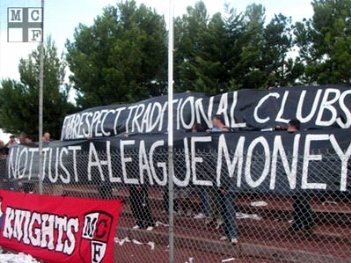
(c) accepting only extant, traditional club teams into a national league rather than composite teams. This model is more likely to keep the second-tier leagues strong as supporters of the clubs left in the second-tier will be less likely to switch to the national league side than under the composite-club model. You would then have a situation similar, at least in theory, to one Midlands-based club being promoted one division in English soccer (say, Birmingham City) while all the others stayed where they were (Aston Villa, Walsall, etc.) It would not have a great effect on any of the divisions/leagues. My preferred options would have been (a) combined with (c).

If any or all of these ideas had been tried perhaps the WAFL might have larger crowds and a higher profile than it has today. However, we must remember Brisbane Strikers’ soccer player Frank Farina’s comments about Australian sporting crowds. English fans “who support Huddersfield Town in division five will [always] support Huddersfield Town”, according to Farina. In the case of English soccer, in the Blue Square Premier League (the former Vauxhall Conference and fifth-tier of the pyramid), the once strong Football League clubs Cambridge United, Luton Town, and Oxford United averaged crowds of 3156, 6816, and 6376 respectively in the 2008-09 season with the highest crowds for these three clubs being 4870, 8223, and 10613 (up to and including 9 November 2008) (source: Non League magazine [UK], December 2009 edition, p. 42). These are obviously very good crowds for teams playing at the fifth-tier of the pyramid and outside the Football League and are indicative of strong supporter loyalty towards these traditional clubs.

Luton Town’s record average home crowd of 13,452 in 1982-83 (source: Luton Town FC on Wikipedia), when the club played in the then First Division, means that crowds dropped only by 55% between 1982-83 and 2008-09 despite a drop of four tiers. In contrast to English fans, according to Frank Farina, Australian fans will only watch, in any significant numbers, what they perceive to be the premier or the national competition in any sport. This caveat must be borne in mind when considering any of my suggested alternative solutions (a) to (c) above. WAFL crowds have fallen by around 75% since 1986 although the WAFL clubs have effectively dropped down only by one tier if we regard the old VFL, WAFL, and SANFL as having all been on tier-one of the pyramid in the pre-West Coast era. We can compare that decline to the 55% drop off in crowds experienced by Luton Town after it dropped by four tiers.

To buy the book Goodbye Leederville Oval about the WAFL in the 1984-86 period:
You can also find the book by typing the book title into Amazon.
SUMMARY: This book will allow supporters to relive great teams, great players, and great matches from a wonderful era in WA football 1984-86 before West Coast Eagles joined the expanded VFL.

OPINION: On the Prison Bars: From Destiny by Dr Norman Ashton (2018), p. 153.

From Destiny by Dr Norman Ashton (2018), p. 153: Given who the opponent was to be in 1997, a letter of 1 September 1995 from Collingwood Pre...